Sunday, January 2, 2022

Lower Zambezi National Park - from puppies to mud

 After our lovely day at Mosi-oa-Tunya, we officially started our safari adventure with Jenny and Andrew. Pete was nearly finished with his antibiotics, but his knee was still warm and swollen. After a couple of last minute email exchanges with his PA, we felt comfortable heading off into the bush knowing we wouldn't be more than a day away from a hospital in Lusaka if things turned pear shaped. 

And so we left from Livingstone, heading east to Mvuu Lodge just outside Lower Zambezi National Park. This was the first of 18 days the four of us would be spending in J&A's 70 series Land Cruiser, which amounts to about a 30 square foot space (that might be generous) for most of our waking hours. Our trip is the longest amount of time anyone has travelled with J&A in their vehicle, but we were not too worried. We have been training for this event since 2013 when we hired a 34 foot sailboat for seven days in Croatia and then again in 2016 when we hired a 36 foot canal boat for ten days in southern France. We travel well together, particularly in small spaces. 

Mvuu Lodge was about 350 miles away, but Pete and I soon learned that it takes much more time to cover long distances in Zambia than in the U.S. Much to J&A's surprise, the roads on this part of our journey were beautiful and relatively free from traffic, but you still have to stop at toll booths and police check points, and slow down for villages and the gazillion goats and cows crossing the road, and pull off the road at opportune moments to pee in the bushes and/or switch drivers. Along with a quick roadside stop for lunch and a bit of provisioning in Chirundu, the trip took us about 10 hours. We knew we were signing ourselves up for some long transit days based on the ambitious (and fabulous) itinerary Andrew created for us, but the hours seem to go by much more quickly when you are traveling someplace new and are engaged by all the things happening along the way compared to a well-traveled route. 

When we arrived at Mvuu (hippo in Nyanja, one of the 72 languages spoken in Zambia) and found our beautiful campsite perched above the Lower Zambezi River. There was plenty of flat ground for the truck with the rooftop tent and our ground tent. We also had our own ablutions block (toilet, shower, sink), complete with hot water, and a waterfront area with table, chairs, and fire ring. After setting up our tent, we headed to the waterfront area to get a closer look at the river and the wildlife hanging out on the grassy expanse next to the river. We immediately noticed the humungous 14-foot long crocodile hauled out on the grass enjoying the afternoon sun. Shortly thereafter, a male elephant sauntered out from the trees and began eating vegetation from the edge of the river. Meanwhile, we could hear hippos wheeze honking in the distance, the occasional baboon scuffle, and the high-pitched cry of the white-crowned lapwing. What a way to end our day! Our camp attendant, Stanley, came over to make sure we were settling in well and that we were aware of the dangers the wild animals posed. He pointed at the crocodile and said quietly to me, "Do you see that crocodile over there? My wife was killed by one while washing dishes in the river in 2018." Then he said to the group, "Watch the elephants because a tourist was killed by one in this campsite in 2017." Well, that was an effective warning! Welcome to Zambia! 

one of the reasons swimming in the river or
standing next to it is not the best idea

my excellent observation skills tell me this is a male

our waterfront area

We had four nights at Mvuu, so our plan for the first day at Lower Zambezi was to visit the Chongwe Waterfall and then drive around in the game management area (GMA), the area surrounding the national park. We wanted to be back at camp by early afternoon so we could do a boat trip down the river, so it didn't make a lot of sense to pay the entrance fee to go into the park for just a short time. J&A had spent time in the GMA on a previous trip and were rewarded with a lot of animal sightings, so the plan seemed good to us. We had also been driving in the GMA for about an hour to get to our lodge the day before and we had seen lots of animals, including elephant and various ungulates. 

After a mostly uneventful first night in our tent (we found a scorpion in the shower and Pete swears the hippos were munching the grass just outside out tent in the night), we got a somewhat leisurely start from camp and soon found ourselves at a very dry waterfall. It was still a lovely area, though, so we did a bit of exploring before the sun drove us back to the truck. As we were driving away from the falls, we met a guide vehicle and stopped to chat. As self drivers, talking with the guides is often a good way to get intel on any interesting sightings. This guide had some great news to share. There was a large pack of wild (painted) dog inside the park. After he gave us directions to the location, we thanked him and drove off, considering our next move. It was about 10 am, so we had plenty of time to get into the park and find the dogs, but entering the park comes with a stiff fee of $135 per day. After some discussion, we decided seeing the dogs, which are often quite elusive and one of the most endangered animals in all of Africa, was worth the extra expense. This was a bit easier for me and Pete to decide because we were on vacation and would be returning to work in three weeks. J&A, on the other hand, had taken a year off from their jobs, so expenses needed to be considered a bit more carefully. 


The directions the guide had given us were excellent, even if they sounded a bit fuzzy at the moment (essentially, drive on the road for awhile and turn left at a big termite mound before the first bridge and the dogs will be on your left 50 m from the road). Sure enough, we drove right to a pack of about 18 adult dogs mostly lounging under the trees, sleeping off their previous night of hunting. The guide told us this is one of the biggest packs of painted dog in Zambia. Others told us that the pack has developed some interesting hunting behaviors because it is so big. The minimum pack size is around six for effective hunting and most are around 12-15 individuals. 

The dogs are beautiful. Each individual has a unique pattern of black, tan, and white color patches, with giant Mickey Mouse ears completing the ensemble. After watching the adults mostly lay around, we saw a bit of activity behind us so decided to investigate. About 40 meters from the adults was a giant pile of painted dog puppies! They were in such a cuddle puddle that counting them was challenging, but we estimated there were about 16 puppies, bringing the total of the entire pack to 32. We guessed the pups were 3-4 months old based on their size. It was quite clear why they were in a separate area from the adults...they couldn't stop moving. At least one was always doing something, usually walking or rolling over the other pups. While the pup bodies were small, their ears looked full grown, giving them an adorable and absolutely ridiculous look all at the same time. 


adult dogs lounging under the trees

pile of puppies!


those ears!

After a couple hours of watching the dogs, Andrew and Pete lobbied hard to explore a bit of the park since we had paid to be in there. It was also past lunch time and getting out of the car to get some proper food was out of the question. Rest assured, nobody was starving. Jenny made sure the snack box was well stocked each day. The thermometer was climbing too, and a bit of time with the air conditioner would not be terrible. The daytime temperature hovered around 105 degrees every day and cooled off to a slightly less roasting 90 degrees at night. 

We wound our way across the plains and towards the river where we expected to find more animals. The landscape is quite bleak on the plains in the dry season with very little vegetation. We saw a few zebra on the plain and came across a group of impala and waterbuck near the waters edge. We were definitely in the heat of the day and things were pretty quiet, animal-wise, so we took one last look at the painted dogs and then started making our way out of the park.


fires seemed to be burning across much of the
country, most set intentionally to clear brush

As we crossed into the GMA, we saw a pair of elephant followed shortly by a leopard in the bushes right next to the road. It stayed crouched for a few seconds and then casually walked away from us. A bit further down the road we came to our first water crossing of the trip where the main road into the park crosses a small river. We hadn't done the crossing in the morning because we drove into the park from another direction, but the crossing was the most direct way back to camp. Standard practice for all water crossings is for someone to get out and walk it to check depth and substrate. After a quick scan for crocodiles and hippos, Pete and Jenny volunteered to walk the crossing. All was well, so away we went through the water with no issues.  


At this point, we had already had a spectacular day, but we were not done yet. About an hour after arriving back at camp, we got into a small boat and headed down the Lower Zambezi for another safari of sorts. We more than doubled the counts on our animal and bird lists, with hippos, crocodiles, elephants, many shore birds, and a carmine bee-eater colony built into the steep bank of the river. We even got to see elephants swimming across the river. It was interesting to see how they kept the young ones in the middle of the pack, presumably to keep them save from crocodiles as they crossed. 

slightly annoyed hippo (mvuu)

saddle-billed stork

carmine bee-eater nests in the river bank


yes, they eat bees (and other insects)


Day 2:
Our first day was going to be hard to beat, so we headed into the park early to cover as much ground as possible. Because camp is about 45 minutes away from the park entrance, we planned to be out for the full day. Usually safari outings occur in the early morning and late afternoon when the animals tend to be most active, but we didn't want to drive back and forth twice. Our second day took us much farther into the park. We stuck to the tracks that were closest to the water, knowing the animals were unlikely to stray too far from that important resource. We were rewarded with so many elephant, impala, and waterbuck as we drove through a variety of woodland, plain, and riparian habitats. The animals were quite skittish, most running away from us before we got close. The elephants often gave us a good stare before either walking off, giving us a few warning ear flaps and trumpets, or resuming eating. The animals could be skittish for two reasons. The most likely is because of poachers, particularly the elephants. There are not many rangers assigned to the park and it is quite large. Second, with Covid, the number of cars moving through the park has been quite low, so it is possible the animals have lost some comfort with vehicles in that time.  


kudu

lovely riparian and woodland habitats

buffalo in the water hyacinth

As we crossed a particularly expansive plain, we took the opportunity to get out of the truck to stretch our legs and look closely at some baobab trees. 
The baobab trees were just starting to flower and put out new leaves in anticipation of the rainy season. Baobabs are easily recognizable by their swollen trunks. Their ability to store water in their trunks is a key adaptation that allows them to survive in Africa and other arid areas, but it also makes them difficult to age. They don't necessarily grow a ring every year like most other trees and multiple stems often fuse together. Scientists have to use radiocarbon dating to age the trees, which is much more expensive than dendrochronology. Scientists have recently found that trees live over 2,000 years, but many have been dying in the last decade. A recent study suggests the deaths may be caused by dehydration and excessive heat. Others speculate disease may be affecting the trees. Either way, climate change likely has a role to play in the death of these iconic trees.


baobab bloom

Our travels through the park also gave us glimpses of some of our favorite animals, namely warthogs and Cape buffalo. Buffalo are not the most charismatic of animals, but they are formidable. 

Pete's all-time favorite animal


lunch along the river - thank goodness for the awning!

white-fronted bee-eater

As we came to our water crossing to exit the park on the second day, a herd of elephants was at the waters edge drinking. This group was not concerned about us at all and proceeded from drinking to mud bathing to dirt showering. We couldn't cross the river until they were finished because they were right next to the road. It was an entertaining slow down, at least. 
 
mud bath time (aka elephant air conditioning and sunscreen)

arriving back at camp just in time for sunset


Day 3:
After an eventful couple of days, we had a slow day in camp. Andrew and Pete tackled some Land Cruiser projects, and we made good use of the pool in the heat of the day after getting temporarily displaced from our campsite as an elephant strolled through camp. 

electrical fun

elephant in camp (note our tent on the far right of the photo)


Day 4:
Knowing this would be a long day, we left Mvuu a bit before 6 am. We arrived at the park gate and were paying our fees when a couple drove up to do the same. Until this point, we had seen very few people in the park. It is one of the lesser visited parks in Zambia, and probably made all the more so by Covid. As we talked with the couple, it became clear very quickly that our political and social viewpoints were quite different so we did a lot of nodding to get through the conversation. We also learned that the couple had roughly the same itinerary as us for the day, which was to do some game viewing and then exit the park via the east road. This is not the route most people take out of the park and was the first of multiple adventure roads Andrew wanted to try. The posts about the road on the overlander forum Andrew reads were not terribly recent, so knowing a Zambian was planning to take the road was somewhat comforting. Even with a similar itinerary, we did not expect to see the couple again, which was fine given some of the particularly off-putting remarks. 

We headed into the park and quickly drove through the areas we had covered the previous two days. As we got further into the park, the scenery became even more beautiful. We stopped at a particularly picturesque spot and noticed some vultures circling quite low in the sky nearby. We drove in that direction and Andrew scanned the landscape with the binoculars and spotted a male lion about a 100 yards away. As we approached, we saw the buffalo he had recently taken down and the object of the vultures curiosity. The lion had made the kill quite recently based on his distended stomach. He really wanted to sleep off his meal, but he did not want to let the vultures take over his buffalo. We watched the lion-vulture dance for quite awhile, much to our amusement. The vultures would find a nearby perch and then fly to the ground quite far from the carcass. Then they would slowly hop closer and closer until the lion had had enough and he would charge the vultures, sending them flying away. Repeat. 


very full-bellied lion


the lion vulture standoff

We eventually needed to move on if we were going to get to our destination before dark, so we carried on and soon came to a small stream crossing. Pete was driving and hesitated as we approached. There were recent tire tracks but it looked quite muddy. It was a pretty short crossing, about 1.5 times the length of the Land Cruiser, so we didn't get out and walk it. Andrew gave Pete the thumbs up so Pete got a running start and summarily got completely sucked into a quagmire up to the rear axle. No amount of rocking back and forth was going to get us out, so other tools were going to have to be employed. Digging, Maxtrax, high lift jack, sticks...we were using all the tools at our disposal. Did I mention it was 105 degrees? And that the mud was shin deep and sticky and slippery at the same time? After about forty minutes of trying to get ourselves out, the couple from the gate miraculously came around the corner and offered to pull us out. Swallowing our pride and relieved at the offer of help, we agreed that pulling us out from the front would likely be easier than trying to pull us out from the back. While they found another way to cross the little stream, we kept digging and trying to get ourselves out. After what seemed like a very long 20 minutes, our rescuers came around from the other direction and pulled us out of the mud hole in one go. I am confident we would have eventually gotten out, but we would have been there for many more hours and one of us probably would have ended up with heat exhaustion.     


photo by Andrew (note the elephants in the background -
fortunately they were not at all interested in us)

freed from the mud pit

We thanked our rescuers profusely, cleaned the mud off ourselves as best we could, rehydrated, and made a beeline for the road that would take us out of the park. It was after 2 pm and driving after dark is generally not advisable, so we started looking for potential campsites along the road. Much of the drive was through rocky and forested habitats, which are not great for camping. We did see some good potential campsites while we were still within the park, but you are not supposed to camp there and we thought we would need to go through a gate and check out with the rangers. Unfortunately, there wasn't a gate and we didn't find any suitable places for camping once we left the park. This meant we had to drive in the dark for about an hour to get to a designated campsite. Not ideal, but we made it in one piece. Sixteen hours after we started our day, we drove into Bridge Camp, washed all the mud off, made a quick dinner, and collapsed into our tents. 


Next up: bush camping, South Luangwa National Park, and another adventure road

Tuesday, December 28, 2021

Zambia! An action-packed day at Victoria Falls

 At the end of October, Pete and I headed to Zambia for our one-year-delayed trip with our friends Andrew and Jenny. Five days before our flight, our plans became highly uncertain when Pete was told a 3.5 week-old bee sting may have turned into a joint infection or blood clot, both of which would preclude him from going anywhere. After some serious string-pulling by his PA, he managed to get a MRI, ultrasound, and multiple blood tests within 24 hours. Fortunately, it turned out to be "just" a tissue infection that required a strong dose of antibiotics. This was a frustrating turn of events because he had been to the doctor the week before for the same problem and they told him to take more ibuprofen. Sigh. With antibiotics in hand, details on the IV antibiotics that he could get at a Zambian hospital if the first course didn't work, and guidance on what to do in case of a suspected case of C. diff (which, or course presents itself exactly like travelers diarrhea), off we went. 

Our flight route took us from San Francisco to Dubai on Emirates Airlines, which was fantastic. We had an overnight layover, and the airline provided us with dinner and a hotel. After a 15 hour flight, it was so nice to lay down before our next seven hour flight to Zambia. We were worried about Covid testing requirements if we left the airport, but the airline assured us it would not be a problem. Sure enough, we did not need to show new test results to go through security in Dubai since we already had our boarding passes and did not have to re-check in for our flight. 

We arrived in the capital of Zambia, Lusaka, in the early afternoon and headed to a camp outside of town to recover from our long flights. We knew that we'd be sleeping in a tent for the next three weeks, so we opted for a proper bed to try to get over our jet lag as quickly as possible. After a good nights sleep and an enjoyable morning at Pioneer Camp, we headed back to the airport for our flight to Livingstone on the southern border of the country. My seat was in the sun for much of the flight, so I was nearly denied entrance to the airport because my skin temperature was too high. Fortunately, the health screener let me sit in the air conditioned room for a few minutes so I could cool down. Whew! 

The plan was for us to have a day touring around Victoria Falls before meeting up with Jenny and Andrew. After we got settled in our tent cabin at the Victoria Falls Waterfront Lodge outside of Livingstone, we headed to the lodge to inquire about our dinner options. As we walked into the parking lot, we spotted a familiar looking Land Cruiser, but we were not completely sure it was our friends' truck until Andrew came around the side. Finding each other was a major success! We had not worked out a communication plan in case something went wrong, and plenty of things can go wrong, so seeing them was a relief. They had arrived a day earlier than planned, but we decided to stick with the original schedule anyway. They needed a day to rest and provision before we headed back out on the road, and we wanted to get a glimpse of the falls.

We started our day at Victoria Falls, or more appropriately - Mosi-oa-Tunya (smoke that thunders in the Kololo and Lozi languages) - with a short boat trip down the Zambezi River to Livingstone Island. The island sits on the edge of the falls, giving spectacular views up and down the gorge. Mosi-oa-Tunya is one of the seven wonders of the world and a World Heritage Site, so we knew it would be spectacular, but being that close to a 330 foot (100 meter) curtain of water was incredible. And we were there in the dry season! Although we were not seeing the full force of the falls, one of the advantages is that we could actually SEE the falls. During the rainy season, the spray from the waterfall is often so thick that you cannot see the falls (hence the name, smoke that thunders). We were greeted with lovely views and rainbows arching across the gorge. Another feature of visiting in the dry season is that you can swim in nature's version of an infinity pool at the very edge of the falls. After a short swim from the island, we were guided to the Devil's Pool, a deep basin with a broad ledge perfect for perching and looking over the edge of the falls. It was exhilarating! Pete and I were the first ones in our group of eight to be guided up to the ledge so we could look over the edge and have our picture taken 100 times. I was pretty happy to get my feet out of the deep pool where we were being bitten, often times quite hard, by some type of little fish. Lying on the rock ledge and looking over the falls was a bit surreal and pretty incredible (and felt completely safe, Mom). We had a lovely breakfast on the island before our boat trip back along the quiescent Zambezi. This was our first look at some of the water birds that we would become quite familiar with as our trip progressed.  


Our first glimpse of the "Smoke that Thunders" from the boat


Standing on the edge of Livingstone Island and a 
good look down the gorge that the water tumbles into

A double rainbow across the gorge

Looking over the edge into the abyss

Look, Mom! No hands! (the guide has my foot)

Pete flying out of the Devil's Pool

Post-swim breakfast

We knew Livingstone Island would likely be our best opportunity for getting a close-up glimpse of the falls, and it did not disappoint. During the dry season, it is recommended to view the falls from Zimbabwe rather than Zambia. Only about a quarter of the falls are visible from Zambia, much of which often has little flowing water during the dry season. Unlike most waterfalls I have seen, Mosi-oa-Tunya falls off the river plain into a wide horizontal gorge (instead of a vertical one), creating the largest falling curtain of water in the world (aka not the tallest or widest waterfall, but collectively the biggest). This gorge, which is closed on both ends, then funnels all the water into another gorge that is perpendicular to the first. The second gorge forms the border between Zim and Zam (imagine an offset "T" where the top bar is the falls and the vertical is the river gorge). Due to Covid-related border restrictions, however, it was going to be a bit of a hassle, if not impossible, to cross over to Zimbabwe for the day.

Back on dry land, our next stop was the Victoria Falls World Heritage Site just down the road. There are a number of walking paths that lead out to various vantage points within the park. After the reading I had done before our trip, I was expecting the falls to be completely dry on the Zambian side, so I was pleasantly surprised by the amount of water cascading into the gorge. There were also very few people in the park, so we mostly had the walking paths to ourselves. One of the other nice things about going to the falls in the dry season is that you can see the underlying geology of the basalt gorge that the river has been cutting into for thousands of years. In fact, downstream from the current gorge are seven other gorges that were the former sites of the waterfall. The river keeps cutting back successively through the basalt fault lines. It is a very clear reminder of how drastically water can alter a landscape. 

Looking down the gorge from the dry side towards 
Devil's Pool.The gorge running off to the left is 
the gorge that takes the water downstream.

End of the gorge on the Zambian side of the falls

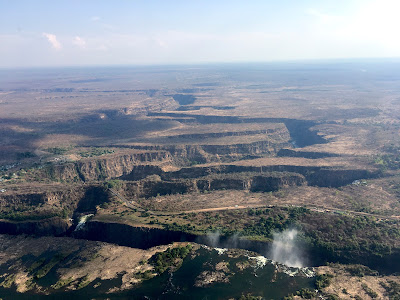
Our last activity for the day was an extra special one. Because we couldn't go to the Zimbabwe side, we decided to take a helicopter flight over the falls, though the series of gorges downstream of the falls, and over Mosi-oa-Tunya National Park. It was my first flight, so Pete let me sit in the front. He has been in many helicopters doing water sampling in New Zealand or getting ferried around in the Antarctic. We were in a small helicopter that sits four people, so it was just the two of us and the pilot. When we arrived they wanted to confirm that we were doing the 17 minute flight, but I told them we wanted to do the 22 minute flight. They are so dialed into their fuel needs that they had to add fuel to the helicopter for that extra five minutes! The flight pattern took us over the falls multiple times, giving us a really great aerial view of the river, waterfall, and downstream gorges. The flight over the falls was amazing, but the gorge was even more incredible. We were feet above the surface of the river, pinned in by the rocky walls, and banking hard to the left and right as we made our way downstream through the seven gorges. Our pilot had clearly done that flight thousands of time (thankfully!). We circled the National Park a couple times, seeing buffalo, elephants crossing the river, and a few zebra before landing back at the hangar.


The full view of the river plain, waterfall and the river gorge 
(the bridge marks the border between Zim and Zam)

Aerial view of the multiple gorges that have 
been carved by the waterfall over time

Flying out of Batoka Gorge


Swimming elephants!

After an exciting day at the falls, we wound down at camp with the monkeys and tried to steer clear of the hippos wandering around after dark. 


this clever monkey knew how to use the hose bib

Next up is the Lower Zambezi, complete with puppies and a stuck Land Cruiser. 

Saturday, December 18, 2021

The hills of Iowa and bridges of Madison County

In early September, I travelled to Des Moines, Iowa, to crew and pace for my sister Stephanie as she embarked on her first 100 mile run. Me and all three of my siblings started running at various points in our lives, either purely for exercise or as an effective way to keep anxiety at bay. Sarah, Steph, and I all eventually started running long distances. This gave us occasional opportunities throughout the years to train and race together. Steph and I trained for our first marathon in 2002 while we were both living in Oregon. We run at a similar pace, which has helped facilitate many joint training runs, as well as quite a few races. 

10 km race with all my siblings 

Sarah took her running to a new level when she started doing Ironman triathlons. They are pretty inspiring races to be around, so I've traveled for three of the five she's done to be her cheerleader and to get some quality time with my niece, Madeline. Spectators are not allowed to provide aid or pace an Ironman triathlete, so being Sarah's cheering section was our lone role. 

Steph has remained focused mostly on running but has increasingly been upping her distance from mere marathons (42 km) to 100 km races. Much to my delight, she has also embraced trail running, which is all my joints allow. We've started doing "destination" races every few years, such as in Death Valley and Joshua Tree. When she offhandedly asked last spring if anyone wanted to crew for her 100 mile race, I jumped at the opportunity. I have no intention of running that far, but helping someone else achieve that goal felt like a pretty worthy endeavor.

I arrived in Des Moines on a Friday afternoon, just in time to pack up Steph's drop bags and deliver them to the race staff. That evening, we talked through logistics of gear, food, and vehicles, and made a rough plan of when her spouse David and I would be jumping in to pace her. Early in our planning for the event, I told Steph that I would pace her for at least 20 of the 37 miles that she was allowed to have someone with her. That gave me a good training target and allowed her to enlist others to pace the rest of the distance. As my training progressed and race day approached, I knew I could cover more distance, if needed, so that became our plan. 

Death Valley trail marathon - 2014

At 3:30 am the next morning, we woke up, made some caffeinated drinks, and packed our gear into the car. The start of the Booneville Backroads Ultra was about 30 minutes away and start time was 5 am. Arriving early to a race is always a good idea because you never know how long the line will be at the port-a-loo.

Just after 5 am, 37 intrepid runners, aged 26 to 62, left the starting line at Badger Creek State Recreation Area. The time limit for the course was 32 hours; Steph was hoping to finish in 26 hours (!). After a fitful night of sleep, thanks to Archie the cat, I decided to head back to Steph and David's house and try to get a couple hours of sleep before finding Steph along the course. 

Last minute gear adjustments

They're off!

Crew were not allowed to drive the exact running route for safety reasons, but there were areas where the "running course" and the "driving course" overlapped. Fortunately for me, these locations were often at or near several of the covered bridges dotted throughout Madison County. We live next to the Felton Covered Bridge (I can see it from where I am writing this post), which is a pretty spectacular landmark. In fact, it is the tallest covered bridge in the country. Still, seeing a variety of covered bridges of pop culture fame seemed like a fun activity for the day even though the bar of comparison was pretty high. There are six intact bridges scattered around Madison County, the highest concentration in Iowa and the western Mississippi River Valley.

Felton Covered Bridge

The first bridge, Imes, was near mile 22 on the race route. I assumed I had missed my sister at this stop, so I took a quick look at the bridge and carried on to Holliwell Bridge at mile 36. It was a perfect day for exploring (and running) - a light breeze, temperatures in the low 70s, slightly overcast skies - so I found a nice rock to sit on and cheered runners on as they came through the bridge.

Imes Bridge - oldest of the bridges; built in 1870

Holliwell Bridge - the longest bridge at 122 feet

Inside of Holliwell Bridge - one of two without a fire suppression system

After waiting for what I thought would be the correct amount of time, my sister had not come through yet. I started getting worried that I had missed her, so I high-tailed it to mile 42 where there was a crewed aid station that would almost certainly be tracking runners as they came in. I knew I would be able to check-in there to see if she was ahead of me. I had the crew bag for mile 50, so I wanted to be sure I was not behind her. As it turns out, I almost certainly left Holliwell Bridge minutes before she came through the bridge. Bummer! 

Leaving the aid station at mile 42

As the running course made its way through Winterset and then to the north, I went a bit further afield to see Cedar Bridge and Roseman Bridge. Cedar Bridge recently reopened after it was nearly completely destroyed by fire. It is also the only bridge still open to vehicle traffic. Roseman Bridge is one of the three bridges that is in its original location. 
 
Cedar Bridge

Roseman Bridge

Back in Winterset, I visited the town park, where the Cutler-Donahue Bridge now sits. It is one of two bridges with a peaked roof and is the shortest in length of all the bridges. I also stopped at a gas station in Winterset to put coffee into my insulated mug. I hardly ever drink coffee, but I thought the caffeine might come in handy later in the night/early morning given my lack of sleep the night before and the little sleep I was expecting in my future. 

Cutler-Donahue Bridge

Lightning strike??

I caught back up with my sister near the Hogback Bridge, the last of the covered bridges. The sun had decided to make an appearance, making things a bit warmer, but Steph was looking great and maintaining a good pace. 

Hogback Bridge

The next aid station was at mile 50, the halfway mark, and our first planned rendezvous site. I arrived at the aid station about 40 minutes before my sister came through, so I cheered on the other runners while I waited. If you ever need a dose of inspiration, go volunteer at an aid station of an ultra and be amazed at the runners that are still upright, moving forward, and often times smiling. Steph came into the aid station at mile 50 right on schedule and ate some much needed calories while I refilled her water reservoir. Runners consume calories out on the route, as well, but the aid stations provide an opportunity for items that are too bulky to carry in your pack like bananas, pb&j sandwiches, and coke.  

Leaving the halfway point

The plan was for me to advance to the 63 mile aid station (also the start/finish line) where I would join Steph on the route as her pacer. After looking at the route, though, I decided to meet her at mile 57 because I was concerned it would be getting dark before she got to mile 63 and I had both of her headlamps. She crested the hill at mile 57 just as the sun was setting, so I was happy I made the stop. There had been some gnarly hills between miles 50 and 57, so Steph's pace had slowed a bit, but she was still in good shape. 


I met up with David at mile 63 where I changed into my running gear, prepped my hydration vest and reflective gear, and waited for Steph to arrive. Mile 63 was the first place the 100 milers could pick up their pacer. I was slated to pace the first 10 miles, David the next 11 miles (so he could go home and let the dogs out), and then I would take another 10 or possibly 16, depending on Steph's needs. Steph came into mile 63 around 9 pm, 16 hours after she had left the start. We headed back out onto the course after getting her some additional layers, lights, and fuel. 

When I mentioned this trip to my co-workers, the first thing many of them said was, "Iowa. Must be flat." I knew better than to expect flat, but the hills of Iowa are no joke! They are not particularly tall or steep, but they are numerous and rolling, so the elevation gain was adding up. Steph wasn't too thrilled with hills by this point in the race, so my job was to "inspire" her to make it to the top of each one. The darkness certainly helped! The night turned quite chilly as fog rolled in, also making navigation a bit more challenging (the course was unmarked). My other job was to try to keep Steph moving forward at a pace that would get her back to the finish line in 26 hours or in 32 hours at the latest. This is the most difficult part of being a pacer, in my opinion. My legs were fresh at that point so setting a pace was no problem for me, but my sister had been running for 16 hours, was likely running a calorie deficit, and was certainly sleep deprived. If you push too hard, you can break a person physically and mentally, but you have to push somewhat because the mental demons telling you to quit are real, especially now that it was cold and dark. We pushed on through the darkness and were buoyed when we saw the lights of the church and aid station 73 appeared in the darkness. 

I drove straight to the aid station at mile 84 so I could try to get a few hours of sleep before heading back onto the course. I was still quite awake when I arrived, but did manage to get some sleep before my alarm woke me at 4:00 am. Based on our pace the previous 10 miles, I expected Steph and David to be arriving near 5 am. I changed into my running clothes again and walked around a bit to loosen my muscles. It was still quite chilly outside, so I hunkered down in the car until I saw a pair of headlamps approaching the aid station. I was also drinking the coffee I had procured in Winterset to give myself a bit of a jumpstart. 

When Steph and David arrived at the aid station, Steph did not look good. She was cold, under fueled because her GI track was in knots, sleep deprived, and probably dehydrated. She was coaxed into a chair by one of the aid station volunteers and quickly covered with a flannel blanket. She wasn't sure if she could keep going, so the volunteers and I were offering anything that might help her go back out: broth, cooked breakfast, coffee, warm coke, a nap. As she was falling asleep in the chair, she looked at me and said, "my mind is broken." At that point I stopped pushing. During a training run in July in MN, we had talked about this run and the mental stamina that would be needed to make it to the end. I asked her how she would know if she needed to stop before the finish line and she told me she would stop when her mind was broken. Steph doesn't remember that conversation well, but it was something that stuck with me. When she said those words at mile 84, I knew that was the end of the run. 

We drove back to Des Moines and got her into bed. David fell asleep shorty thereafter in the recliner; he hadn't gotten any sleep during the night. Remember that coffee? Yep, sleeping was NOT in my future. My body was twitching because of the caffeine so I headed out for a run to get it out of my system. It took 15 miles for that to happen! 

Steph was disappointed to be logging a DNF (did not finish) for the event, but I reminded her that she had just run 84 MILES (!), 21 miles farther than she had ever run and 80 miles farther than most anyone else on the planet wants to run. I was happy I could be around for a couple days after the run to help her process her experience and realize that she had accomplished something amazing, even if it was not what she had envisioned. As I get older, I realize more and more that we have to fail to learn and be better. This is not something our culture focuses on, particularly with social media feeds that are filled with "perfect" stories of success. We just have to be willing to learn from our failures rather than let them hinder our progress. I am so proud of my sister and have no doubt that I will be crewing/pacing her again sometime soon.

Saturday, August 21, 2021

Birthday sloths!

 First things first. I am not one tiny bit embarrassed that I celebrated my 43rd birthday in the same way Pete's cousin's daughter celebrated her 7th birthday. Why? Because, SLOTHS! 

A bit north of San Francisco in a residential Sonoma County neighborhood, you will find a house filled with a wide assortment of animals that have either been confiscated, surrendered, or orphaned by a closing facility. None of the animals can be returned to the wild, so they are used for educational programs to teach people about the animals and their habitats in the hopes of inspiring conservation. 

Enter Covid and the subsequent school closings, which resulted in a near total loss of revenue for this small but mighty organization. Like many people over the last 18 months, they were forced to pivot and opened a small part of their facility to visitors. After a glowing review for Safari Encounters from Pete's cousin, Pete decided to take care of all of his family member's summer birthdays in one fell swoop. 

Our visit included time with five different animals from South America: the two-toed sloth, matamata turtle, three-banded armadillo, caiman lizard, and dwarf caiman. We also got time with the brown skunk, Ernie, an extra treat. 

The two sloths were the stars of the show, as expected. One of the sloths begrudgingly took the blueberry treats from us and then promptly went back to napping, while the other sloth continuously climbed around the room trying to figure out how to get in on the blueberry action. Their movement is so interesting to watch, especially as they navigate obstacles with their characteristic curved claws. Interesting sloth fact: they go to the bathroom about once per week and lose ONE THIRD of their body weight in the process! 

feeding blueberries to Willow (Photo by Brandi)

super fascinating toes/claws

Chewy REALLY wanted some blueberries


sloth fur starts at the stomach and grows toward the
back, the opposite of most other mammals. It helps
them shed water while they are hanging out in the trees.

The three-banded armadillo tried to steal the show from the sloths. We got to hold him while he was waking up and then turned him loose in the habitat. He explored every nook and cranny to find any scraps of food the sloths had dropped. Armadillos mainly eat termites in the wild, so they have long claws on their front feet for digging. Instead of their claws being out in front of their feet when they walk (like a dog), they walk on the tips of their claws. I thought it looked like he was prancing around in high heels. 


Roomba was waking up in very jerky movements -
I was worried about dropping him! (Photo by Mike)

Armadillos do not have very good sight, so the shield on
their head protects them when they run into things.

Our extra for the day was a brown skunk. It is the same species as the black and white variety, but it was bred to have a brown coat so people would not be tempted to try to make pets out of the skunks in their backyards. Even deskunked, Ernie still had the tell-tale smell of a mustelid (weasel family). He was very soft and sweet, though. 

(Photo by Pete)

We had a great time learning about the animals and the organization. If you live near Sonoma and want to support an organization that is doing great things, check out Safari Encounters. You will not regret it!