From Hakone (see last post), we continued south to Kyoto and checked off one of my travel goals - riding the Shinkansen bullet train. We boarded the train at Odawara, which was not a stop for all trains, so we got to see just how fast the bullet trains travel (no slowing down for stations). The train we were on travels at a maximum speed of 200 mph. When the ~400 meter-long trains came through the station, they would pass in under four seconds! Imagine how cross-country travel could be in the States. Sigh.

Once we arrived in Kyoto, we had a new transportation map to study to find our lodging for the night. Kyoto was the imperial capital from 794 to 1868 and is one of the few large cities in Japan that was not destroyed during World War 2. That means there are many, many old buildings in Kyoto, which is in stark contrast to Tokyo. Continuing on our tour of the different types of lodging in Japan, we stayed at a Buddhist Temple in the northern part of the city. Our walk from the train station to the temple was our only major outing in the rain the entire trip, which seemed pretty remarkable for January. Once we got settled in our rooms, we walked to Kinkaku-ji, the Golden Pavilion. On our walk to the temple, we came across a wood blockprint shop that had many beautiful works. My second travel goal was checked off when we found a piece to bring home.

the Golden Pavilion covered in gold leaf

Pete and Erin on our only slightly rainy day

The roof ornamentation varies depending on the temple, but
it all serves the same purpose of warding off evil spirits.
it all serves the same purpose of warding off evil spirits.

The office woman at the temple gave us some recommendations for restaurants that were within walking distance. We decided to try a place called Rakuraku. There were no diners at the restaurant when we walked in, so we sat in three of the eight chairs along the bar facing the kitchen. The chef, Akira, placed a binder in front of us and opened it to the page below, asking what we like and if we have any allergies.


beef sushi in the back...not sure about the rest of it

Shunkoin Buddhist Temple - our lodging in Kyoto

Myoshin-ji Temple - in the same complex as our lodging
While staying in northern Kyoto, we also visited Arashiyama, home of more temples and the famed bamboo forest. We started at Tenryu-ji Temple, a UNESCO world heritage site, which led us to the bamboo grove, via the lovely gardens. After our wandering, we completed one of Pete's travel goals, a trip to and purchase at the shop of the oldest knife maker in Kyoto (dating back to around the 1200s).


lovely handrail details

Arashiyama bamboo forest


a small, but very dense stand of bamboo

Rent-a-kimono was quite popular in Kyoto.

Tanuki statues were also abundant in Kyoto. Tanuki is a shape-shifting
raccoon-ish looking bear (a real animal) with a magic scrotum
(legend). The raccoon suit in Super Mario 3 is tanuki-inspired.
raccoon-ish looking bear (a real animal) with a magic scrotum
(legend). The raccoon suit in Super Mario 3 is tanuki-inspired.

Art hotel in Kyoto - each room is an art installment.
Slightly nerve-wracking when moving around, but fun.
Slightly nerve-wracking when moving around, but fun.

Pontocho Alley

Along the Philosopher's Walk, a lovely stroll through a quiet neighborhood
Kyoto has the largest remaining geisha population, but it is rapidly dwindling in size. Gion is the main area where geisha work and live and is a lovely old part of the city. While walking around Gion one evening, we did see geisha walking to their evening engagements. As tourists, though, having the opportunity to spend an evening with a geisha is incredibly rare (and expensive), so we decided to go to a cultural show to learn about multiple Japanese arts, including the tea ceremony, flower arranging, traditional music, and geisha dance. The puppet show was not being offered that evening, so they offered us the opportunity to take a photo with the maiko, or geisha in training. Slightly awkward, but sort of like taking a photo with an endangered species?

maiko (geisha apprentice) performing a Kyoto-style dance

Southern Kyoto has one of the most picturesque shrines in all of Japan, Fushimi Inari Taisha. Foxes are the messengers for Inari, the Shinto god of rice, so fox statues featured prominently here. In addition to the foxes, Fushimi Inari is most famous for its gazillion vermillion torii (gates) that straddle the paths throughout the grounds. Despite the lack of people in most of my photos, there were so many. With a bit of patience, you could occasionally sneak a photo sans people in between the groups winding their way through the torii.

fox with the key to the rice granary


so many gates!

gates from above - it is hard to tell from within
that they are all different heights
that they are all different heights

There were areas throughout the grounds with smaller shrines
for worship with mini torii that were donated by people.
for worship with mini torii that were donated by people.


About an hour south of Kyoto by train lies the ancient capital of Nara, which was the capital until 784 when it was moved to Kyoto. There are eight UNESCO sites within the small city, nearly all shrines or temples. The other draw of Nara is the sacred deer that roam the city and occasionally harass tourists for some deer crackers. We were told by a volunteer guide that you should not just hand over the crackers...the deer have to bow for them first. They are, in fact, well-trained deer and most bow for a cracker. Some are also jerks that try to eat your jacket, pants, or backpack if you are not fast enough with the crackers.

chicken adornment at Kofuku-ji

five-storied pagoda (national treasure)
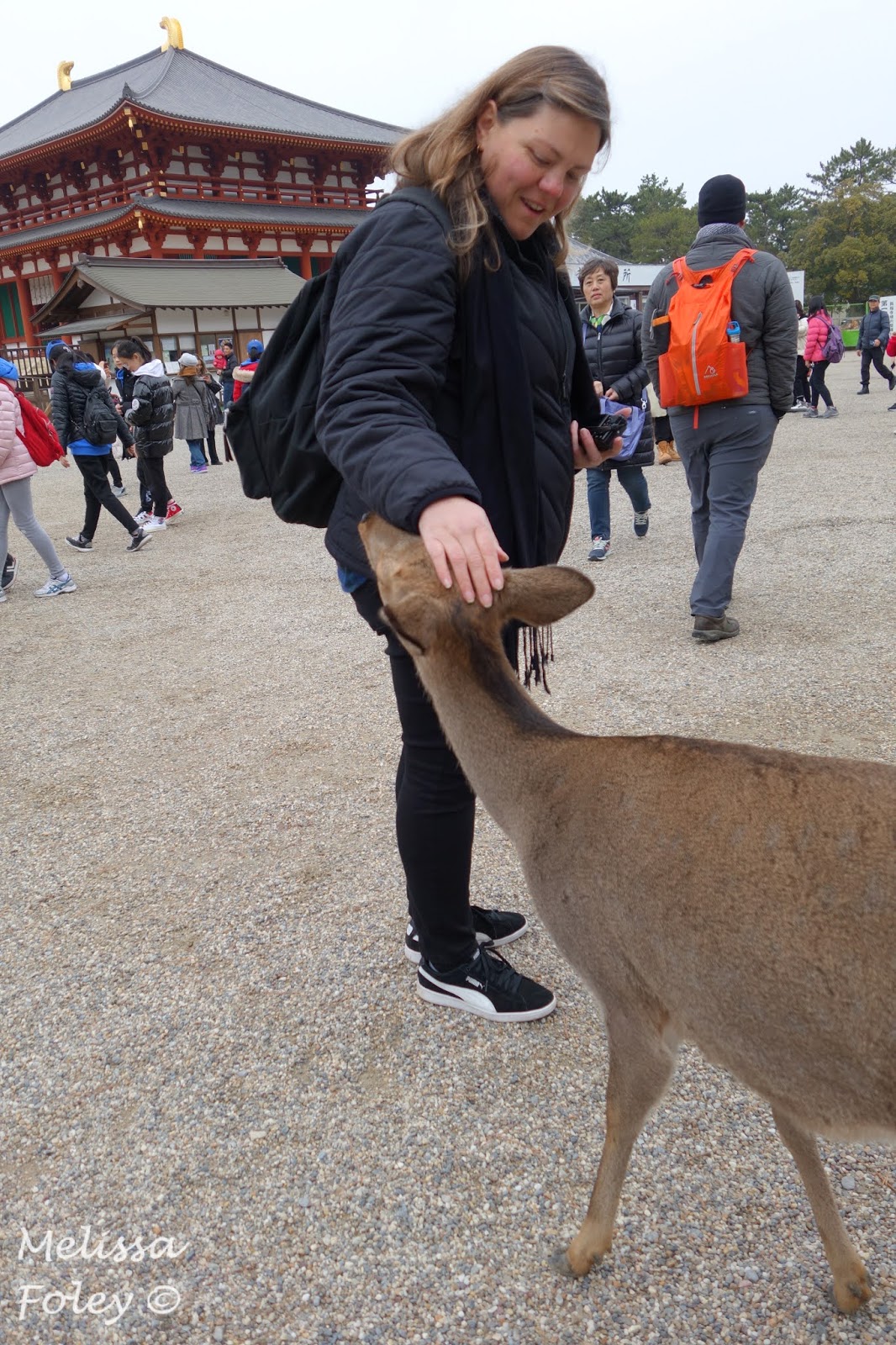
Erin and a sacred deer of Nara

Deer congregating in front of a cracker stand, but are
amazingly not rushing the vendor to try to eat them all.
amazingly not rushing the vendor to try to eat them all.

look at that good bowing (and then he tried to eat my backpack)
(photo by Erin)

The massive Great Buddha Hall at Todai-ji; it was the
world's largest wooden building until 1998, measuring 160
feet tall, 190 feet wide, and 165 feet deep.
world's largest wooden building until 1998, measuring 160
feet tall, 190 feet wide, and 165 feet deep.

The Great Buddha Hall houses a 50-foot tall
Buddha, the world's largest bronze Buddha.
Buddha, the world's largest bronze Buddha.

One of the pillars at the back of the Hall has a hole cut in it that is
supposedly the size of a nostril on the Buddha statue. Anyone who can
fit through the hole is granted a degree of enlightenment in the next life.
(photo by Erin)
supposedly the size of a nostril on the Buddha statue. Anyone who can
fit through the hole is granted a degree of enlightenment in the next life.
(photo by Erin)

Enlightenment, here I come! (with Pete's help)
(photo by Erin)
Up the hill from Todai-ji, and a bit off the beaten path, is Kasuga Taisha, a Shinto shrine and lantern wonderland. While not quite as numerous as the torii at Inari, there were hundreds of bronze and stone lanterns hanging from the rafters and lining the pathways.


stone and bronze lanterns

photo by Erin

they had a dark room with ~100 or so lighted lanterns - so neat!


surrounded by lanterns
(photo by Pete)
(photo by Pete)
Our last, colorful temple in Kyoto is called Kiyomizu-dera, which sits on Mount Otowa overlooking Kyoto. The temple was founded in 778, but like nearly every other temple we visited, has burned in multiple fires between the time of founding and the present day. The current buildings are from the 1600s...still older than most buildings in the US, even on their tenth iteration.


I am a sucker for the design lines on a pagoda

and cool dragons...I'm a sucker for those too


fancy lanterns

From Kyoto, we headed back to Tokyo via the bullet train. Three hundred miles in two and a half hours (with multiple station stops)...so good! We stayed in a different part of Tokyo for our last night, in the northeastern part of the city called Asakusa. We rounded out our lodging tour with a stay in a capsule hotel. It was an interesting night in a tiny wooden box, separated from the common space by a curtain. Pete was nonplussed - it was just like any night spent on a ship for him. I was pleasantly surprised by how quiet the place was, despite quite a few people staying there. I cannot imagine that model of lodging working nearly anywhere else in the world. The capsule hotel requires people to be quiet, respectful, and follow the rules...not exactly a common combination, except in Japan. I have to say that that combination was something I loved about the country. I know those qualities largely stem from centuries of oppression and dictatorships, but there are a few benefits amongst the atrocities.

My box for the night. We got earplugs at check in, and each "room" had
a little fan to circulate the air. The walls were thin, but people were quiet.
a little fan to circulate the air. The walls were thin, but people were quiet.

Most of the interior space in our book-centric capsule hotel
Tokyo's oldest and most popular temple, Senso-ji, was a block from our hotel. It is one of the few temples we visited that was open after 5 pm and lighted, which was fun to see. Everything is big at Senso-ji - the lanterns, the wooden statues, and the crowds. We got in one last sushi boat dinner before heading back to our capsules.


I think our plate stack was even bigger than our first night
We had about half a day in Tokyo before our flight, so we walked along the Sumida River and then hopped on a boat for a little tour of the riverfront. We did not have enough time to get all the way out to Tokyo Bay, but we did get a far-off glimpse of the Statue of Liberty replica.

many cool bridges on the Sumida River

space-agey boats ferry people up and down the river

Tokyo sky tower in the background; Asahi beer headquarters in the
foreground. The golden thing is supposed to be the Asahi flame,
but is colloquially referred to as the golden turd, for obvious reasons.
foreground. The golden thing is supposed to be the Asahi flame,
but is colloquially referred to as the golden turd, for obvious reasons.

Sea level rise gates that can be closed to protect low-lying areas
of Tokyo from being inundated during high tides and storms.
of Tokyo from being inundated during high tides and storms.
We really enjoyed our trip, have fond memories of the bidets (a heated toilet seat is delightful!), added many woodworking and art projects to Pete's list, and are trying to replicate the medium boiled eggs that are salted in the shell (magical). We are also feeling quite fortunate that we got our trip in before the mayhem of COVID-19 took the world by storm.
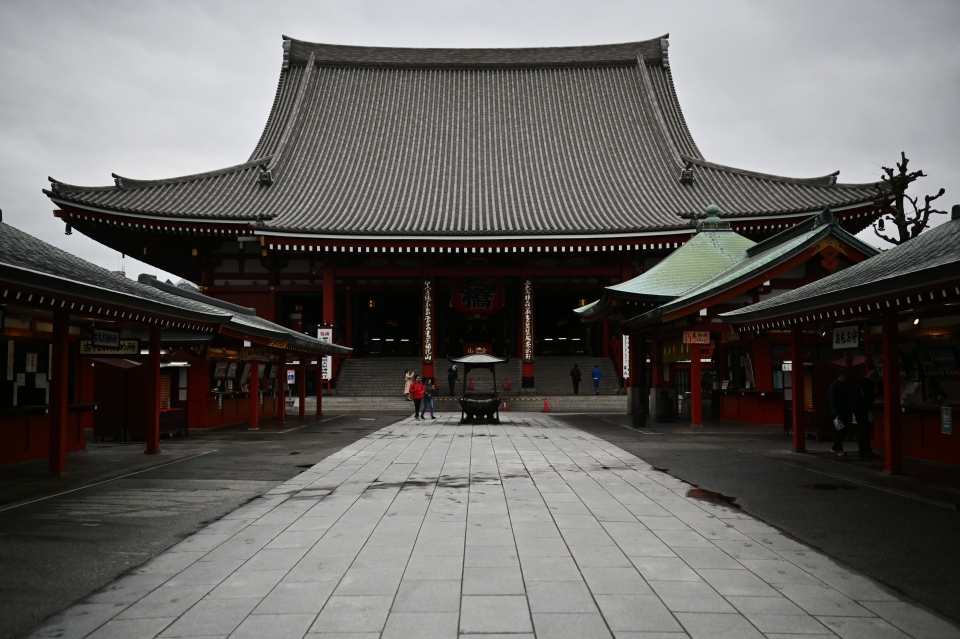
Senso-ji Temple last week - quite a comparison to our day there (below)
Photo by Charly Triballeau/AFP via Getty Images

The main temple building at Senso-ji (the large building in the photo above),
prior to "social distancing" becoming the most commonly used phrase of 2020.
prior to "social distancing" becoming the most commonly used phrase of 2020.


