Saturday, November 30, 2019

Camping throughout California and other summer trips

The second half of summer and nearly the entire fall have gone by much too  quickly. We got in a couple of trip together to see family and friends. Pete was in the field for two long stretches of time, which prompted me to take some solo camping trips to tick some places off my "to visit" list. 

Pete was working in the northwest corner of Washington State for a few weeks in July. He got a short break in the middle so we met up in Olympia to spend the weekend with Tish, Morgan, and the kiddos. Pete had not seen the kids since we left for New Zealand, so we were overdue for a visit. We had a lovely weekend catching up, making jam, watching the Lakefair parade, and enjoying summer in the PNW. 


In August we headed to Minnesota for double family time. I went a few days before Pete to see my mom and Cole-dog. We all met back in Minneapolis for a family reunion with Pete's family and a brief visit with the rest of my family. Pete's cousin Jess and her family live in Minneapolis, and it was their turn to host the family reunion. The Neukirch's are spread from California to Massachusetts, so every few years we gather in one of four locations. When we go to Minnesota to visit my family, we spend very little time in Minneapolis, so it was fun to explore on foot and bike with the family. 


We managed to spend three weekends at Pete's family camp in the mountains this summer. We often struggle to get up there once a year, so we were quite pleased to get so much time up there this summer. After a wet winter and late spring, we were treated to an abundance of wildflowers in July that we usually do not see. On our last trip, we convinced Pete's parents and sister to join us. It was the first time in over twenty years that they have all been at camp together. In all cases, the river was its usual bone-chilling cold! 


At the beginning of September, Pete got on a ship for five weeks. Instead of coming home to an empty house every weekend, I went camping. The first trip was to Castle Crags State Park in northern California. The park is just off Interstate 5 and has been on my list of places to visit for years. The crags are 6,000 foot tall granitic spires that formed over 170 million years ago. They crags are a distinctive feature of the surrounding landscape and share the limelight with Mount Shasta near the southern terminus of the Cascade Mountains. The park was relatively quiet in mid-September, so there were plenty of campsites left when I arrived. I hiked over twenty miles in two days and had most of the trails to myself. 


The next weekend I camped at Mount Madonna, a nearby retreat center, for a three-day yoga retreat. Since moving to the East Bay part time, I have really missed my yoga teacher in Santa Cruz. The retreat was a chance for me to get my fill and reconnect with many of the yogis that I've come to know from her classes. The retreat center has miles of trails, lots of wildlife, and is also home to the most-visited Hindu Temple in the Bay Area. The food was delicious and they had many options for me, which is always a bonus. 


In late October, we ventured down to Santa Barbara to visit friends and to see our friend's chocolate shop. Mike started Twenty-Four Blackbirds chocolate about ten years ago in his home kitchen. Pete and I got a taste of his work then and have been fans ever since. Recently, he expanded into a new location, complete with factory, retail space, greenhouse, and experimental lab. He has five varieties of single origin bean-to-bar chocolate and has an assortment of truffles that are divine. He is also making gummies using the juice from the cacao plant. They are really unique and quite good. Look Mike up if you are ever in Santa Barbara; it is totally worth the trip to see a small-scale chocolate factory at work. We brought home the cocoa bean husks to use as mulch and our entire yard now smells like chocolate. Yum. 

blocks of melted but untempered chocolate


Mike explaining his fancy packaging machine

the tell-tale feathers of Twenty-Four Blackbirds chocolate

The final camping trip in this mega-blog was meant to be a joint venture to Joshua Tree National Park in southern California. However, Pete came down with a case of Hand, Foot, and Mouth disease (Yes, that is an actual thing. No, it is not common in adults.) that left him incapacitated due to the incredibly painful blisters on his feet. I was bummed to go on my own but could not postpone the trip because sister Stephanie and I were meeting to run a night-time half marathon. I arrived at my campground outside the park just before sunset and settled in for the evening. The next morning I explored around the visitor center while waiting for Steph and David to arrive from LA. We spent most of the rest of the day getting our race gear, finding food that all three of us could eat (no small feat), and prepping for the run. The run was just outside the park on the sandy desert roads. We started running at about 6:15 pm, so the sun was down and the stars were out. There were so many runners on the course that I did not turn on my headlamp the entire run! It was neat to look behind to see a highway of headlamps running through the desert. There were some unhappy dogs along the course that probably thought the end was nigh. It was a lovely run under the stars with my favorite running buddy.


The day after the run, we explored inside the park. It was the first time all three of us had been there. The Joshua Trees are so interesting and must have been the inspiration for Dr. Seuss's book The Lorax. The billowing granite formations add to the other worldly feeling of the place. The sad reality is that Joshua Tree is on a trajectory to be the second national park to lose its namesake. Glacier NP is likely to be first, followed closely behind by Joshua Tree. The warmer temperatures and drier conditions at lower elevations within the park are hindering new Joshua Trees from flourishing. So go visit while you can still see the trees!


the lovely Joshua Tree


the impressive (and pokey) cholla garden 


Friday, July 12, 2019

Looking up at the stars

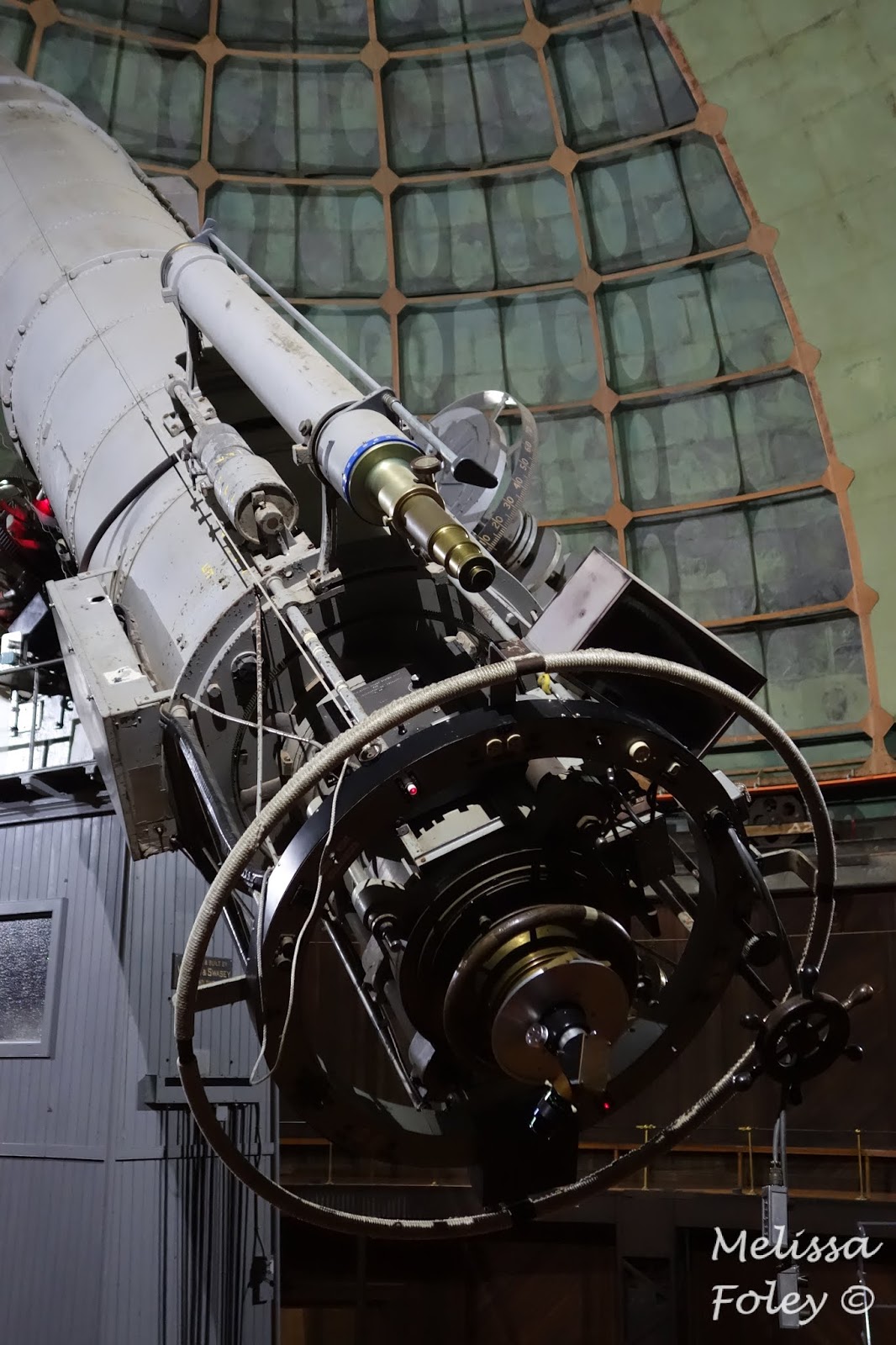
The Lick Observatory is located on Mount Hamilton, approximately 4200 feet above San Jose, California. The Observatory, owned by the University of California, was built in 1888 and was the first permanently occupied mountaintop observatory in the world. The Observatory was soon home to a 36" refracting telescope, the largest in the world for over a century. The fifth moon of Jupiter was discovered through the telescope in 1892 more than 200 years since Galileo discovered the first four. 

the 36-inch dome

The "town" of Mount Hamilton, which at one time included a cafe,
post office, houses for researchers, and a school for their kids.

South San Francisco Bay in the distance


The Observatory is open to the public most of the year, but you only get to look through the telescope on a special tour. As if booking tickets to a rock concert, I logged onto the ticket system one minute after sales began and managed to get two tickets for the end of June. The first eight dates had already sold out! We headed up the windy road to Mount Hamilton and ate our dinner overlooking San Jose and South San Francisco Bay. Our tour started at 6:30 pm and would last over five hours as we learned about the telescopes, life at the observatory, the eccentric man behind the place. And last but definitely not least, we got to look at the stars. 

In addition to the 36 inch, the Observatory is also home to four active telescopes and two historical ones. The Shane 3-meter telescope is the main workhorse of the observatory. The telescope is booked every night for the next 18 months! The 3-meter is a reflecting telescope, meaning it uses a mirror to generate an image rather than lenses like the Giant Refractor. The mirror was a test blank made by Corning Labs, the makers of Pyrex, and was acquired by UC for a song at $50,000 in the 1950s. They promptly insured it for $2 million! The 3-meter is used for adaptive optics and for determining the chemical composition of stars. It also has a laser that detects the distortion in the atmosphere that makes stars twinkle. It is lovely to see a twinkling star, but for astronomers that results in a blurry image. By correcting for the distortion, they can get a clear image of the star and make precise measurements. 

The 3-meter reflecting telescope

The opening of the dome spins to where it is needed; the green
carriage is the old elevator used to get to the top of the dome.

Circumambulating the dome

The other telescope we learned about is the automated planet finder. This is a relatively new telescope at Lick that works on its own every night to try to find planets that could support life. Astronomers tell it which stars to look at and the telescope measures the velocity changes in the star's movements, indicating that a planet could be pulling on it. 

home of the automated planet finder

The whole place was made possible by James Lick, who made the largest scientific donation in history - $700,000 or $1.2 billion in today's money. Lick made his early money as a piano maker in the U.S. and South America, but his fortune ballooned when we arrived in San Francisco months before gold was found at Sutter's Mill. He became a real estate tycoon in San Francisco and seemingly started the escalation of Bay Area home prices that continues today. Lick was somewhat of a curmudgeon but wanted to leave a legacy in the Bay Area before he died. His original plan was to build gigantic statues of himself and his parents at the mouth of the Golden Gate. Some friends dissuaded him, suggesting the statues would be targets in times of war. His second scheme to build the largest pyramid on Earth at 4th and Market in downtown San Francisco was also shot down. Finally, some science friends suggested he build the largest observatory ever built and that seemed to satisfy his need for grandness. Lick died before the Observatory was fully operational, but his body was buried beneath the Great Refractor before the floor was installed. Soon after, the telescope saw first light and the rest is history. 

James Lick, the man with the money


It was a really fabulous night for looking at the stars. The staff opened the dome and the cold air came rushing in. It is no wonder they do not do public tours in the winter! The staff then proceeded to move the telescope to the first viewing location entirely by hand. The telescope is balanced perfectly and allows them to move the 57-foot long, 25,000 pound telescope like it is a piece of plastic. It was spectacular. The floor of the dome can move up and down, but the State of California won't certify it for use with visitors so we had to use a portable staircase to look through the telescope. When the dome was built, the floor was moved by water power. After a bit of searching, the staff focused in on a binary star. It looked about like you would expect...two stars. :) The second item was the M5 cluster, which was beautiful. It was inspiring to be looking through a telescope that has made many discoveries and advanced the field of astronomy by leaps and bounds over the last century. If you ever get a chance, I would highly recommend a visit. We were a bit sleep deprived at work on Monday but it was totally worth it!


Saturday, June 29, 2019

Early summer outings

It is easy to forget that summer is here when you work on or near the ocean in much of northern California. "The coldest winter I ever spent was a summer in San Francisco" is a pretty apt description of the temperature differential between inland locales and the coast. This year, June Gloom has been in full swing thanks to the heavy fog that blankets the coast most days. Pete has been wearing a rain coat when he bikes to work in the mornings because the fog is so thick and wet. The fog tends to burn off by midday, giving way to warm summer days. The garden seems to be thriving in the morning fog and afternoon sun rotation, with the plants seemingly doubling in size between the time I leave Monday morning and return home Thursday night. 

Our new hive of bees is also benefiting from the rapid vegetation growth all around. They were a little slow to find the nectar and pollen sources, but in our hive check today we saw quite a bit more pollen stores than we had seen a couple weeks ago. We have not been super impressed with this batch of bees. They are, by far, the laziest hive of bees we have had, so it is nice to see that the girls are actually starting to put up some food stores and generally figuring out how to be industrious bees.


a bit of capped honey at the top of the frame
and some capped brood in the middle

The conditions this year have also been good for an infrequent bloomer at the UCSC arboretum. The puya is a native to the Andes Mountains in South America. It is in the bromeliad family and is the only species that grows in the ground instead of on other plants. The plants tend to bloom only once in their lifetime and can take up to ten years to bloom. The plant is about 6 feet tall and the flower spike is another 4-5 feet tall. It is a pretty impressive plant. The color of the blooms is also incredibly beautiful and like nothing else I have ever seen. The arboretum is also a great place for watching (and getting buzzed by) hummingbirds, and they did not disappoint that day. 


 Pete's favorite - the California quail

Anna's hummingbird

Last weekend we headed out for another camping trip in the Wish 5. The Los Padres National Forest is a vast stretch of public land that stretches from Monterey to Ventura. We've spend a lot of time on the western side of the forest along Big Sur, but have not explored the eastern side of the range much at all. Some friends pointed us in the direction of some good campsites and we were off. The eastern side of the coastal range is significantly warmer than the western side, so we were quite happy to find a camp site close to a small creek with lots of shade and some good swimming holes. There are some neat rock formations in the area that seem to be of a similar origin to the rocks at Pinnacles National Park where we hiked earlier in the spring. The camping spots in the area are all unimproved so we had to bring in everything we needed for a couple of days. We have a new list of improvements to make the Wish a better platform for that kind of camping. Given the demand for improved sites nearby, this place will be a good option for future trips close to home.

 there were at least five different kinds of dragonflies - so lovely!

lots of mating pairs too

and an otherworldly molt from the nymph stage

bouldery Santa Lucia Creek


cool sycamore trees in improbable locations

yucca blooms

there were tons of clarkia blooming everywhere


We had to ford this stream - a first for the Wish 5

By the time we finished hiking around on the rocks, the temperature was rocketing towards 100 degrees. We started our drive home and stopped at the Mission San Antonio de Padua, the third mission established by the Spanish Franciscan order as they moved their way north through California in the late 1700s. This is one of the few missions where no town grew up around it. The closest sizable town is about 30 miles away. As a result, the Mission has been struggling to stay in existence since the early 1900s.

Father Junipera Serra, founder of the California Missions


I had never seen this before - the cattle brands for
many of the Missions. Notice any similarities between the Mission
San Diego brand (upper left) and the San Diego Padres logo?