Saturday, May 12, 2018

Birthday weekend in the geothermal hotspot

For Pete's birthday last weekend, he requested a trip to the geothermal wonderland of NZ, Rotorua. The area sits within the Taupo Volcanic Zone, an active geothermal field covering about 250 kms from north to south. Rotorua was one of the earliest tourist destinations in NZ. It was home to the famed pink and white terraces, sometimes referred to as the eighth wonder of the natural world. Shiploads of people would arrive from the UK, Europe, and America to see the terraces and bathe in the hot mineral waters. The terraces were presumed destroyed in the late 1800s when Mount Tarawera erupted, burying everything around under a thick layer of mud and ash. However, in 2017 a team of scientists discovered that the terraces are still intact but are buried beneath 50 feet of mud and ash. 

Artist's rendering of the white terraces (Charles Blomfield)

The Taupo Volcanic Zone is one of the four most active geothermal areas in the world along with Yellowstone, USA; Kamchatka, Russia; and Iceland. The Rotorua area is surrounded by a vast array of features, including mud pools, boiling crater lakes, geysers, smoking fumaroles, and colorful sinter (solidified mineral deposits) terraces. The smell of sulfur is immediately apparent when you arrive in town, and it is not uncommon to see steam rising from the ground throughout the town and the surrounding area. The geothermal activity is harnessed in the area for residential heating and hot water baths. The holiday park we stayed at even had a natural hot pool!

There are a number of areas around Rotorua that will take your money in exchange for up close encounters with the geothermal features. We chose Waiotapu because it has a range of features within a relatively small area, including geysers, boiling mud pools, sinter terraces, and CRAZY colored lakes. 

Lady Knox geyser steaming...

...and erupting

Devil's ink pots (color from graphite and crude oil)

another one of the Devil's ink pots

the Artist's Palette

the Primrose Terrace - the largest remaining sinter
terraces in NZ after the burial of the pink & white terraces
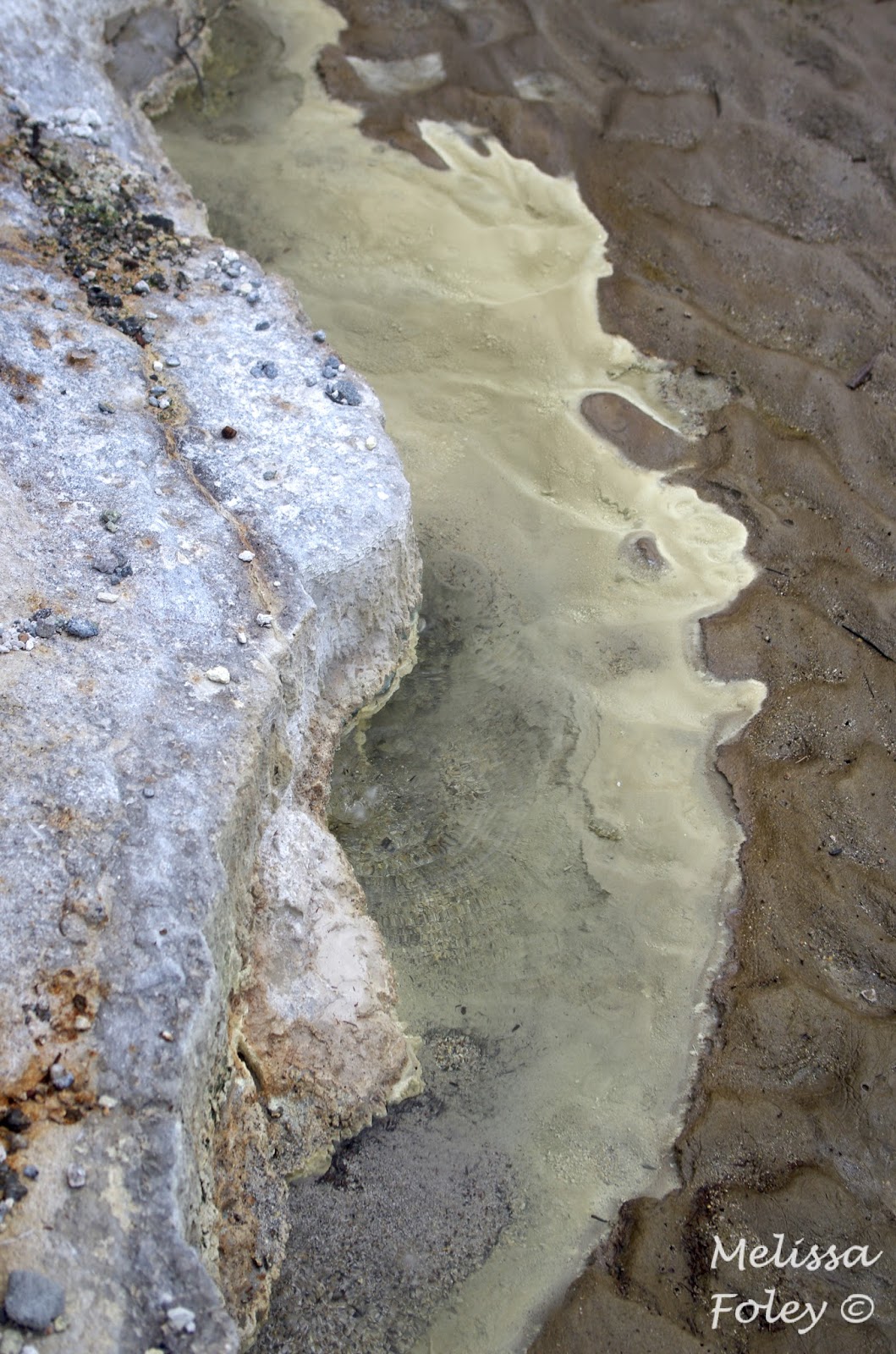
alum, sulfur, and sand

the coloration from sulfur is amazing!

the emerald green waters of Lake Ngakoro

the lower Primrose Terrace

the sinter surrounding the Champagne Pool

The otherworldly Devil's Bath! 

 
pool of boiling mud

Exploding mud is fun to watch!

After spending much of the day at Waiotapu, we walked through Kuirau Park in the middle of Rotorua, a free geothermal area with interesting, but much less colorful offerings. Our holiday park was right next to the thermal park, making for an easy outing. 

hot mud and boiling water

birthday boy

steamy lake at sunset

The forecast for the next day called for showers throughout the morning so we headed out to the museum at the Buried Village of Te Wairoa. The area was one of the many villages buried when Mount Tarawera erupted in 1886. The Smith family purchased the land in 1931 and began excavating the site to see what buildings they could find from the former village. They found remnants from a Maori storehouse, town hotel, and many dwellings. They also excavated many personal effects from the sites, including dishes, clothing, and tools. Most everything was buried under about a meter of mud and ash. There is also a lovely stream running through the property and a series of waterfalls. The Smiths built a track to the waterfall in the 1930s and was one of the highlights of the visit. 

the Maori storehouse - note the stone carvings either side of the entrance


Pete's birthday umbrella is as strong as advertised!

Lake Tarawera (volcano on the right in the cloudy distance)

It was fun to explore another geothermal area on the planet. That crosses three of four off the list for me - Iceland, here we come!

Thursday, May 10, 2018

Another visitor!

We have been fortunate to have so many visitors come through NZ since we've been here. They have not all come to visit us, per se, but we are really grateful when they take extra time to visit. A couple of weeks ago, my friend Brock graced us with his presence for three days at the tail end of a work trip. He's always up for an adventure and was ready to be out in nature, so we did the best we could in the short time we had with him. 

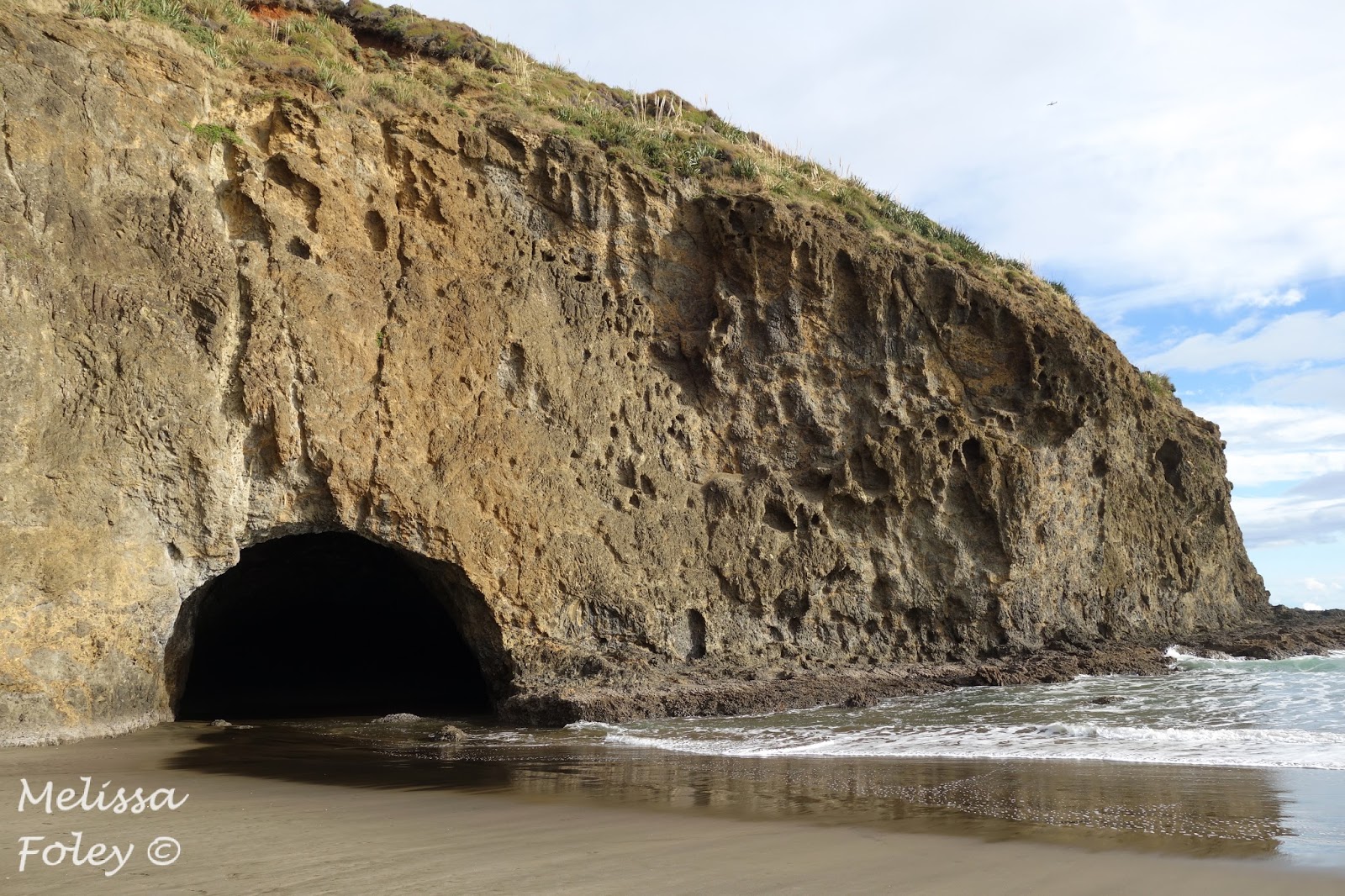
We headed out to the black sand beaches of the west coast on day one. We explored the beach at Te Henga, including a cave and some phenomenal geological formations. The area used to be the eastern flank of the Waitakere Volcano that erupted 15 to 22 million years ago. It was the second largest volcano ever to erupt in NZ. Te Henga was the site of one of the lava flows that extended under the ocean, creating pillow lava and hyaloclastite formations. There are also a lot of examples of volcaniclastic rocks that have been reworked by rivers and the ocean over time.  

microbial mats on the walls of the sea cave

looking north from the cave

pillow lava

volcaniclastic rocks

columnar basalt formed by rapidly cooled lava

From the beach, we hiked over the giant black sand dunes and around Lake Wainamu. We used every ounce of daylight, finishing our hike as twilight set in.

Lake Wainamu with the giant sand dunes in the distance

The following day was a holiday so Pete and I were off from work. It was a beautiful day for a trip north to see glow worms and birds. We first visited Waipu Cave when Jenny and Andrew were here a couple months ago. We thought it was so neat that we wanted to take Brock too. We were not disappointed! The glow worms are really spectacular and there are a lot of interesting limestone formations in the cave too. We explored a bit more of the cave this time around and found some chambers that we missed on our last visit. A large storm came through NZ about a week before we went to the cave and we could see how high the water had gotten inside by the debris marks on the cave walls. That is not a place you want to be in high water!


The little dots are all glow worms. They make
the cave walls look like a starry sky.

After a picnic with a spectacular view over the Whangarei Harbour, we headed to Tawheranui Regional Park to see kauri trees and find some native birds. The birds did not disappoint that afternoon. We even got a good look at a kaka and were treated to its crazy range of calls. Brock finished the day with a swim on the beach at sunset. It was the perfect end to a great day. 

our beautiful lunch spot

kaka (lowland parrot) chattering away in the kauri tree

morepork (ruru) sizing us up

Brock swimming in the other side of the Pacific

Thanks for the great visit, Brock! 

Friday, April 13, 2018

Easter with the big trees

The Easter weekend seems to mark the unofficial end of summer in NZ. Good Friday and Easter Monday are both official holidays here so it is the last long weekend until we celebrate the Queens birthday in June. We've had something going on most every weekend since mid-February so we decided to split the long weekend between home and adventuring. 

On Saturday afternoon, we headed to the Kauri Coast about three hours northwest of Auckland. As the name implies, there are a lot of kauri trees in the forests up there, including some of the biggest in the country. The forests are pretty fragmented, though, and are surrounded on all sides by forestry blocks of Monterey pine and pasture as far as the eye can see. 

When we arrived at the holiday park, we got a map and a description of the key tree species around the park. Being the nerds we are, we hoped out of the car and wandered around the park looking for the green and yellow number blocks. Our map mentioned that the man who started the holiday park had botanical interests, so he planted the diversity of mostly native trees and shrubs on the property. I've been working on my tree ID skills since we arrived here, but it is difficult! The bark is similar for a number of trees that isn't the best guide and often the foliage is far above you and hard to see. It was really nice to have the numbers and the names of the trees so I could learn them a bit better.  

On Easter morning we drove five minutes up the road to Trounson Kauri Park, a 586-hectare reserve with LOTS of kauri trees. The Department of Conservation has been doing a lot of work in the reserve to try to remove pest predators and to restore the forest. It is considered the best example of a native kauri forest in NZ. The structure of the forest was quite different than the forests around Auckland. Here there are canopy and sub-canopy trees, shrubs, and ferns, which all together form a pretty formidable wall of vegetation. At Trounson, there were the canopy trees--dominated by kauri--and the ferns near the ground, but very little in the middle. It was a beautiful forest and we thoroughly enjoyed our quiet morning walk. It took us 90 minutes to complete the estimated 40 minute loop. We enjoyed it so much that we went back two days later and walked the track in the opposite direction before heading home.

showing the absence of foliage between the ground cover and canopy

Pete looking at the big trees -
our necks were sore after the weekend!

gum at the base of a kauri tree - a lot of gum is
usually a sign of disease, either gumosis or kauri
dieback, both of which can ultimately kill the tree

The bark is completely split on this kauri so
the tree will be dead soon. The dead trees can
stand in the forest for decades before falling over.

a good example showing the kauri actively shedding
its bark (on the left edge of the tree in the center of
the photo) to reduce the number of plants growing on it

many, many lovely ferns on the forest floor,
including this silver fern fiddlehead 

The manamana, or hen and chickens fern. It is very distinct because
of the "chickens" that emerge on the top of the adult fronds. These
vegetative growths can drop off and form a new clonal individual.

climbing fern

From Trounson we made our way further north to the Waipoua Forest to see the big trees. Enroute we stopped at a roadside souvenir shop that had pieces of swamp kauri gum for sale. The gum is fossilized resin of the tree that has been buried underground for thousands of years. A significant geologic event 30 to 40,000 years ago caused widespread destruction of the kauri forest across its entire range. Scientists hypothesize either a large volcano or tsunami downed thousands of trees across the North Island. Over time, those trees were buried by ash or sediment and were well preserved underground. As the land was developed, people started finding the large trees buried in the ground. Swamp kauri, as it is called, is now the only way to get kauri wood for building because the living trees are completely protected. When the gum is harvested out of the ground, it is coated in an almost crystalized layer of the resin. If you rub the gum it has a very strong turpentine-like smell to it. You can remove the crystalized layer with sandpaper to reveal glowing orbs of golden resin. I'm very excited about our little gum pieces! Pete, meanwhile, was much more interested in the wood part of the swamp kauri. We stopped at a wood shop on our way home where he found a couple of boards that he is going to use for one of his upcoming projects. It is a very soft wood with almost no visible grain, which should be good for his hand tools. The wood is a lovely, warm chestnut color.

unpolished kauri gum pieces

a hint of the golden color that lies below

The Waipoua forest is the largest track of native forest in Northland and is home to some of the biggest kauri trees in NZ. The largest is called Tāne Mahuta (lord of the forest), estimated to be about 1,500 years old! This tree is massive - it is 45 feet around (it would take about nine of me to circle the tree with arms outstretched) and 168 feet tall. The first branches start 55 feet above the forest floor, which is precisely why this tree was prized by loggers and shipbuilders in the 1800 and 1900s. Like big trees around the world, kauri trees were nearly lost due to over harvesting. Public pressure started mounting in the 1950s to protect the remaining trees throughout the North Island. All kauri trees on crown land have been officially protected since 1987 and many kauri on private land are also now protected. Kauri trees are dwarfed in height by coastal redwoods and giant sequoias, but they are the third largest tree in the world by volume of wood.    

Tāne Mahuta, the giant

This long, straight tree makes Pete drool

the four sisters - four kauri trees growing close
together, showing their tall, straight profiles

The second largest kauri is Te Matua Ngahere (father of the forest).
He is wider than 
Tāne Mahuta at 54 feet in diameter but shorter
at only 100 feet tall. He is also estimated to be older by about
500 years. Te Matua Ngahere has a large bee colony residing in
the tree - the dark patch in the center of this photo. We could
even hear them buzzing from about 300 feet away!

After the trees, we headed to the Kai Iwi lakes for a hike. The lakes are outside of the protected forest and adjacent to pine plantation so no kauri trees here. There are three lakes adjacent to each other and only one of them, Lake Kaiiwi is free from boats, so we chose to walk around that one. There was an abundance of mosses and ferns that were quite different than what we saw in the kauri forest. Learning about them after our trip, they are all typically found in highly disturbed areas and at the edges of forests. 

Lake Kaiiwi

club moss

a top-down look at the club moss - I loved its helix structure

Umbrella fern - this would probably be a pretty good umbrella. All
of the fronds are woven together, creating a very dense mat of foliage.

creeping club moss

I love our adventures and exploring new places. Hopefully the weather will cooperate this autumn and into the winter so we can continue exploring! (It is very much NOT cooperating this weekend.)