In October we went to Bonaire--one of the islands in the Dutch Caribbean--for a week of diving with our friends Clint and Arin. None of us had been there before, but it is a dive destination with some of the most intact coral reef habitat in the Caribbean. The whole tourist industry is also set up for divers. Most people fly to the island on Saturday, dive for six days, and fly out the following Sunday. The rental car companies almost exclusively rent extended cab trucks (mostly the Toyota Hilux - one of Pete's favorite trucks in the world) for transporting wet dive gear around the island. All of the dive sites are marked with yellow rocks, and the dive stores sell packages for six days of unlimited air fills. Many of the dive shops have multiple locations so you can swap tanks easily without having to go back into the center of town, Kralendiyk.

Bonaire lies about 50 miles due north of Venezuela. The island has been inhabited since around 1000 AD first by Arawak Indians from Venezuela and later by the Spanish, Dutch, and British. The official language is Dutch, but most people on the island speak Papiamentu, an interesting mix of Arawak, Spanish, and Portuguese. When the Dutch conquered the island in the 1600s, the Dutch West India Company established a post on the island, starting a long history of slavery in Bonaire. The slaves were mainly used in the salt works and to grow food crops. The slaves were freed in the mid-1800s, but there are still reminders of that history on the island, including the slave huts. The huts are tiny - about 6 x 8 feet in area and just over 4 feet in height so you cannot stand upright inside the hut. There would be twelve to fifteen people assigned to a single hut, making anything but standing or sitting impossible.

The salt works is still in production but uses a conveyor belt to deliver salt to ships rather than slaves. The salt piles and condensing ponds are impressive, colorful sites to see. There are four triangular obelisks on the leeward side of the island in different colors - orange, white, blue, and red - the colors of the Dutch flag. These colors signified to sailors where they should anchor for different grades of salt. The salt condenser ponds cover a large swath of the southern third of the island, but they also support a population of Caribbean flamingoes.


The reefs were in quite good shape for the Caribbean, and there was a lot more soft coral than I anticipated. There were a lot of fish too, making for some very colorful dives. Most of the sites were a single reef system that started in about 20 feet and ended in 110-130 feet of water. There was one site that had a double reef - the first ended in about 90 feet of water and then we swam across a sand flat to another reef that dropped off deeper than we wanted to go. In the north of the island, there were some spur and groove reefs that were really different. We swam down the reef face and then as we swam perpendicular to shore, it was kind of like going up and down hills, except it was reef intercepted by sand channels. We saw some critters on that dive that we hadn't seen to the south. We also took a day to do a couple of boat dives on the windward (eastern) side of the island. This was our best chance to see big pelagics, like sharks and rays. We didn't see any sharks, but did spot a couple eagle rays and a remora followed us the whole dive looking for a buddy. There was no shortage of turtles...see saw about a gazillion green sea turtles. One of the sites we dove is one of three places in the world where green sea turtles sleep. Who knew?! At one point on that dive, I counted 18 sea turtles in my field of view. My camera also flooded on that dive, so no photos. At least it was the last day of diving...?
Here are some examples of the coral, hard and soft varieties.


A bit of an oddity on the island are the free-roaming donkeys. They were used during slave times to move good to ships and grow crops. When the slave trade ended, no one wanted to care for the donkeys so they were turned loose to fend for themselves. That didn't work out too well for most of the donkeys, so a donkey sanctuary was established on the island. We didn't visit the sanctuary, but did get to see a few of the "wild" donkeys roaming the island.

All in all, a great trip with good people. Thank you, Bonaire, for rekindling my love of being underwater!


most of the dive sites were marked
by these yellow rocks
by these yellow rocks
Bonaire lies about 50 miles due north of Venezuela. The island has been inhabited since around 1000 AD first by Arawak Indians from Venezuela and later by the Spanish, Dutch, and British. The official language is Dutch, but most people on the island speak Papiamentu, an interesting mix of Arawak, Spanish, and Portuguese. When the Dutch conquered the island in the 1600s, the Dutch West India Company established a post on the island, starting a long history of slavery in Bonaire. The slaves were mainly used in the salt works and to grow food crops. The slaves were freed in the mid-1800s, but there are still reminders of that history on the island, including the slave huts. The huts are tiny - about 6 x 8 feet in area and just over 4 feet in height so you cannot stand upright inside the hut. There would be twelve to fifteen people assigned to a single hut, making anything but standing or sitting impossible.

slave huts at Red Slave
The salt works is still in production but uses a conveyor belt to deliver salt to ships rather than slaves. The salt piles and condensing ponds are impressive, colorful sites to see. There are four triangular obelisks on the leeward side of the island in different colors - orange, white, blue, and red - the colors of the Dutch flag. These colors signified to sailors where they should anchor for different grades of salt. The salt condenser ponds cover a large swath of the southern third of the island, but they also support a population of Caribbean flamingoes.

piles of salt ready to be loaded onto ships

conveyor belt that takes the salt across
the road and to the ships
the road and to the ships

blue salt obelisk and a ship being loaded with salt

orange salt obelisk
The diving was fantastic. And SO easy. We did sixteen dives in six days and for most of them we were underwater for over an hour. The water was clear and warm (mid-80s), and we felt free as birds in our tropical dive gear. Pete and I do most of our diving for work and in ocean water between 42 and 55 degrees. I wear a drysuit for most of my dives these days with about 20 pounds of weight, and the only exposed skin on my body is around my mouth. We also tend to dive in places where seeing the hand in front of your face can be a challenge. In Bonaire, we would put on our shorty wetsuit, add 8 pounds of weight, and walk into the crystal clear water. It was magical and reminded me of how much I love being underwater.

The reefs were in quite good shape for the Caribbean, and there was a lot more soft coral than I anticipated. There were a lot of fish too, making for some very colorful dives. Most of the sites were a single reef system that started in about 20 feet and ended in 110-130 feet of water. There was one site that had a double reef - the first ended in about 90 feet of water and then we swam across a sand flat to another reef that dropped off deeper than we wanted to go. In the north of the island, there were some spur and groove reefs that were really different. We swam down the reef face and then as we swam perpendicular to shore, it was kind of like going up and down hills, except it was reef intercepted by sand channels. We saw some critters on that dive that we hadn't seen to the south. We also took a day to do a couple of boat dives on the windward (eastern) side of the island. This was our best chance to see big pelagics, like sharks and rays. We didn't see any sharks, but did spot a couple eagle rays and a remora followed us the whole dive looking for a buddy. There was no shortage of turtles...see saw about a gazillion green sea turtles. One of the sites we dove is one of three places in the world where green sea turtles sleep. Who knew?! At one point on that dive, I counted 18 sea turtles in my field of view. My camera also flooded on that dive, so no photos. At least it was the last day of diving...?
Here are some examples of the coral, hard and soft varieties.

two different kinds of brain coral

star coral

pillar coral

whip coral on a deep reef wall

soft coral galore - sea rods & sea plumes

and more soft coral!

solitary disk coral
The sponges were amazing! They were everywhere, seemingly taking over the coral in some cases, and came in every shape and color.

azure vase sponge

chimney sponge

stove-pipe sponge

branching vase sponge

orange elephant ear sponge (with grouper)

elephant ear sponge

vase sponge

red encrusting sponge

tube sponge with cup corals

encrusting sponges unite!
There were quite a few critters that were less obvious than the sponges and coral. What do you see here?


From top to bottom - peacock flounder, spotted scorpionfish (not for touching!), and the common octopus. Pete managed to spot a clingfish on one of our dives, but the photo is not great. These tiny fish - about an inch in length - live inside the fire coral. Touching any coral can kill it, but you especially do not want to touch fire coral because it has stinging cells on it's surface that make your skin feel like it is burning, hence it's name. It feels like stinging nettle but stronger. We were very careful to not brush the fire coral while searching for the little fish.
There were loads of obvious critters too. Our favorite by far and away were the two manta rays that cruised by us on two separate dives. The squid and cuttlefish were pretty neat too.

The lionfish is an invasive...Pete and Clint had lionfish burgers.

club anemone

conger eels in the sand flats

moray eel (at least six feet long!)

Pete with his favorites, the goat fish

Caribbean reef squid

green sea turtle

trumpetfish colored to match and staying very
close to it's friend, the spanish hogfish
close to it's friend, the spanish hogfish

lots and lots of brown chromis

lizard fish

banded coral shrimp

cuttlefish

green bristle worm

feather worms on brain coral

the lovely manta ray with two remora hitchhikers
When you breathe air out of a bottle while scuba diving, nitrogen gas accumulates in your body tissue. If you ascend to the surface too quickly, or say, fly to 30,000 feet soon after diving, you risk the nitrogen gas forming bubbles and causing decompression sickness, or "the bends." That would be bad, so nearly all divers wait at least 24 hours from their last dive before getting on a plane. We followed this protocol, which meant we had a land day in Bonaire. There are not a lot of attractions on land because the island is a desert. But the lack of vegetation allows you to see the history of the island up close and personal.
The island rose out of the sea as a result of underwater volcanoes around 120 million years ago. Over time, the island has been steadily pushed upwards by the same volcanic activity and coral that was underwater soon finds itself on dry land. As a result, the geology of the island is layer upon layer of fossilized coral reef. These two distinct fossilized coral layers here are from around one million (top, darker layer) and 200,000 years ago (bottom, lighter layer), respectively.


shell fossils

light keepers house built on the old reef

dead coral has many uses on
the island, including this walkway
at Slagbaai National Park.
the island, including this walkway
at Slagbaai National Park.
Because the island is made of old coral reefs, the interior is porous and can be eroded by water that seeps through the surface. That means caves! The caves are not advertised at all, but our host pointed us in the general direction of a couple. It is a little amazing we found them at all because the directions were a bit like this: "park on the side of the road by the white house with the blue roof and find the goat trail. Walk down and wind around and there will be a hole in the ground and a ladder going down." One of the caves had big pools of water so we could swim to different parts of the cave. The caves don't get a lot of traffic so the stalactites and stalagmites were intact and beautiful.

There are a few charismatic land critters. Land iguanas were common in the northern parts of the island where the climate is a bit dryer. Unfortunately, people feed them and they have become pests in some places.
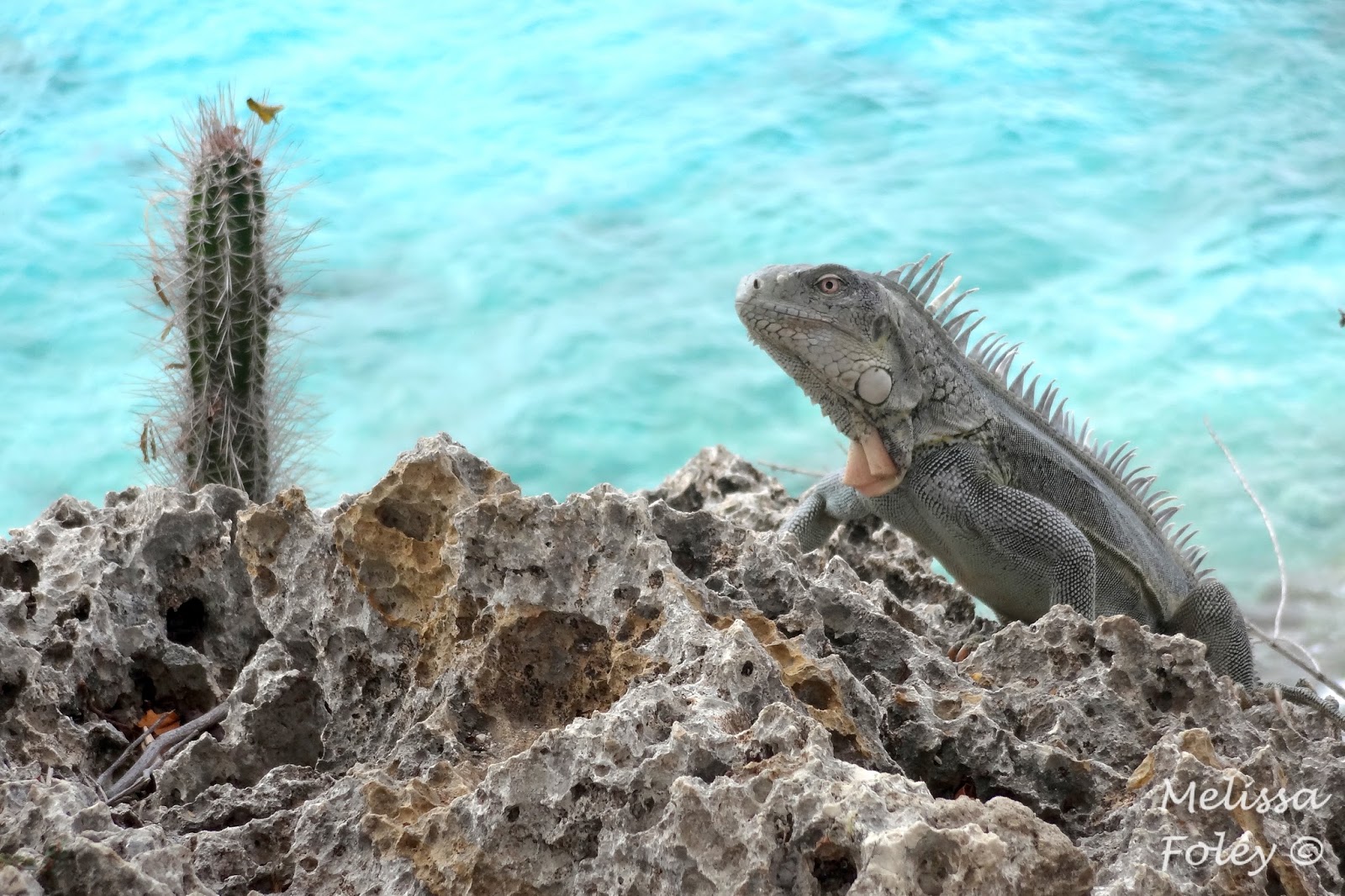

Beggars at the feast! If you look closely, there
are five blue whiptail lizards and one iguana
(two more iguanas behind me) waiting for us
to give them food. When we did not oblige they
become more insistent - one even ran up my back!
are five blue whiptail lizards and one iguana
(two more iguanas behind me) waiting for us
to give them food. When we did not oblige they
become more insistent - one even ran up my back!
A bit of an oddity on the island are the free-roaming donkeys. They were used during slave times to move good to ships and grow crops. When the slave trade ended, no one wanted to care for the donkeys so they were turned loose to fend for themselves. That didn't work out too well for most of the donkeys, so a donkey sanctuary was established on the island. We didn't visit the sanctuary, but did get to see a few of the "wild" donkeys roaming the island.

free-range donkey
All in all, a great trip with good people. Thank you, Bonaire, for rekindling my love of being underwater!